
A concrete garage floor feels solid underfoot, yet over the years small cracks, pits, and rough patches start to show up. That first thin line across the slab might not seem like a big deal. For many homeowners, concern begins only when pieces start to chip away or the car bumps over a low spot near the door. That is where careful concrete garage floor repair makes a real difference.
In New Brunswick, garages work hard. Freeze–thaw cycles, road salt, heavy vehicles, and years of use all push concrete to its limits. When cracks stay open, water slips in, freezes, and forces them wider. Spalling, pitting, and crumbling can follow. Left alone, what began as a hairline defect can lead to uneven slabs, safety hazards, and even discussion of full garage slab replacement.
Most garage floors can be saved. Once the cause and type of damage are clear, it becomes much easier to repair a garage floor in a smart way. This guide walks step by step through inspection, DIY crack fillers, epoxy repair, advanced methods such as slab jacking and foam injection, and long‑term maintenance like garage floor resurfacing. With more than sixteen years of hands‑on experience around Fredericton, Atlantic Brick and Stone shares what works in this climate so a homeowner can decide when to try DIY repair and when to call a concrete specialist.
By the end, you will know how to spot different damage types, how to fix garage floor cracks with the right materials, what affects garage floor crack repair cost, and how to keep a repaired floor in good shape for many years.
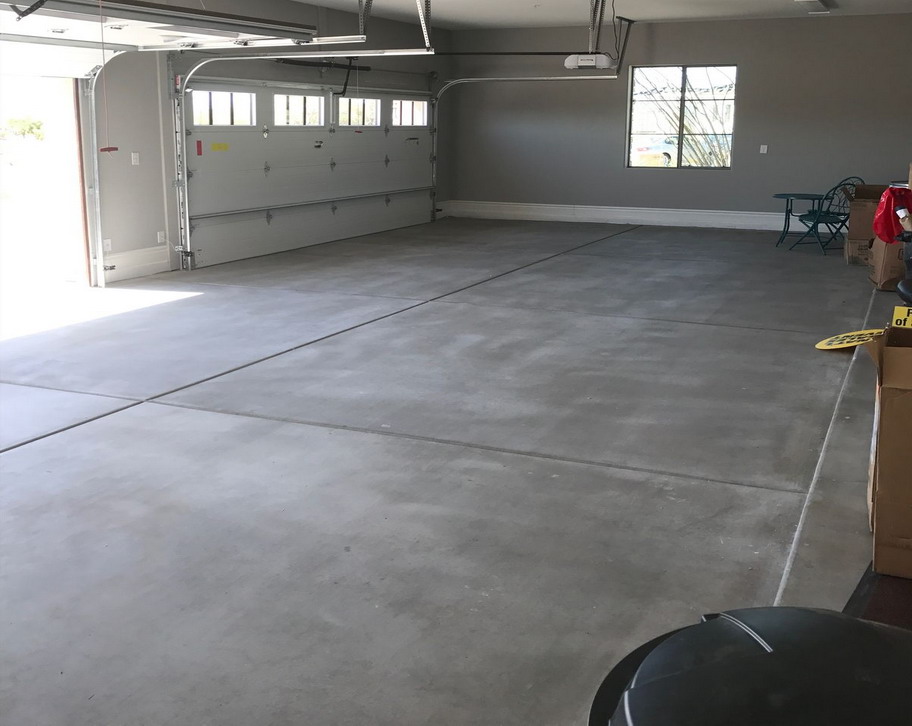
Concrete looks solid, yet it moves and reacts to its environment more than most people expect. Many cracks in a garage floor start right after the pour, while others show up slowly over several winters. Understanding why damage appears helps with both repair and prevention.
Common causes include:
Natural shrinkage during curing – As fresh concrete dries, it loses moisture and pulls inward. This movement creates internal stress, which often shows up as fine hairline cracks. They may seem minor, yet each one can allow water and salt into the slab.
Soil and base issues – If the base was not compacted well, or if drainage sends water under the slab, the ground can settle or wash away. Voids form and the concrete above drops, which leads to wider cracks or whole sections that sink. In New Brunswick clay soils, that movement can continue for years.
Climate and freeze–thaw cycles – Water that seeps into even tiny gaps freezes in winter and expands, pushing cracks wider and breaking off surface layers. De‑icing salt from vehicle tires speeds up this breakdown and leads to pitting, spalling, and concrete that feels rough and brittle.
Heavy loads and poor installation – Large trucks, loaded shelving, or a heavy workbench that rests on small feet all focus stress into a small area. If the slab is thin, the mix had too much water, or control joints were poorly placed, the floor responds badly to that stress. Vibration from frequent traffic and normal building settlement adds more strain.
All of these causes show up on the surface in different ways, which the next section explains.
Not every defect means the same thing, and not every crack points to structural trouble. A quick, careful look at the floor helps sort minor cosmetic issues from damage that needs professional attention.
Key damage types include:
Hairline cracks – Faint, pencil‑thin lines that often cross an otherwise sound slab. They usually come from early shrinkage and often stay shallow. On their own they rarely signal major failure, yet they still act as tiny channels for water and salt. In a Canadian winter that is enough to start long‑term damage.
Medium to large cracks – When a gap is as wide as a credit card or more, or when a crack seems deep, it often ties back to soil settlement, heavy loading, or movement in the foundation. If one side of the crack sits higher than the other, the slab has shifted and there is a clear sign of movement below the surface.
Spalling and pitting – Spalling shows up as flaking or chipping of the top layer of concrete. The surface may look rough, with thin flakes lifting off, especially near the garage door where snow and salt drip from vehicles. Pitting appears as small round holes or shallow depressions scattered across the floor. Both conditions often trace back to freeze–thaw cycles, de‑icing chemicals, or a weak surface finish.
Uneven or sunken slabs – A wheel that drops as it crosses the floor, or a visible slope toward one corner, usually means the soil below has settled or washed out. Patterns also matter. A single straight crack that follows a control joint is less worrying than a web of random cracks or several lines that grow over time.
When damage looks extensive, or when cracks keep changing, a professional assessment from a team like Atlantic Brick and Stone is a wise next step.
Concrete damage rarely stays frozen in time. Once a crack or surface defect appears, each freeze–thaw cycle and each season of salt and moisture adds more stress. Quick concrete garage floor repair keeps a small problem from turning into a major project.
Open cracks allow water to reach the interior of the slab and even the base material below it. During winter that trapped moisture freezes and pushes the crack wider. Over several years, the surface can start to scale, pit, and crumble. At that stage, a homeowner may face not just crack repair, but full garage floor resurfacing or even garage slab replacement.
Safety and use of the space suffer as well:
Raised edges near cracks create trip hazards.
Wheels on tool carts, strollers, and bikes catch on lifted areas or fall into depressions.
Dust from deteriorating concrete makes the garage harder to clean and less pleasant as a workshop.
There is also the question of resale value. During a home inspection, cracked and rough garage floors stand out and suggest delayed maintenance. That can raise questions about hidden issues under the slab or in the foundation. Early garage floor crack repair usually costs far less than late structural work. Atlantic Brick and Stone focuses on repairs that address root causes such as water exposure and settlement, which helps avoid repeat problems and protects the value of the property.
For minor cracks and surface issues, a handy homeowner can often handle basic repairs. A short checklist of tools and materials makes the work smoother and safer.
Safety gear – Safety goggles for flying chips, a dust mask or respirator for fine dust, sturdy work gloves for sharp edges, and knee pads for time spent on the floor.
Cleaning equipment – A wire brush and stiff broom to remove loose material from cracks and pits, and a shop vacuum to clear dust from deep inside gaps. In some garages, a pressure washer and a concrete degreaser help remove old oil and grime before any filler goes down.
Crack preparation tools – A hammer and cold chisel to open narrow cracks and remove weak concrete around a pit, and an angle grinder with a masonry blade for widening or smoothing edges. A simple measuring tape helps track crack width and depth.
Application tools – A trowel and putty knife to pack patching compounds into defects and smooth the surface, a caulking gun for polyurethane sealants or some epoxy fillers, and a mixing bucket with a paddle or sturdy stick for blending two‑part products correctly.
Repair and finishing products – Cement‑based patching compounds, epoxy fillers, flexible polyurethane sealants, concrete bonding agent, foam backer rod for deep gaps, and a high‑quality concrete sealer with a brush or roller for final protection.
For anything beyond small cracks and shallow pits, or when specialized tools such as foam injection rigs or industrial grinders might be needed, Atlantic Brick and Stone offers free assessments in the Fredericton area to help decide whether DIY garage floor repair is practical or if professional help is the safer choice.
Good preparation is the base of any long‑lasting repair. Most failed crack repairs trace back to poor cleaning, loose concrete left in place, or bonding surfaces that were still damp or oily.
Deep clean the area
Scrub the surface with a wire brush.
Sweep with a stiff broom.
Use a shop vacuum to pull fine material out of every gap.
Treat oil stains with a concrete degreaser, scrub well, and rinse.
The goal is to leave clean, sound concrete that a filler can grip.
Widen and shape the crack
Very thin, sharp‑edged cracks do not hold repair material well. Use a cold chisel and hammer or an angle grinder with a masonry blade to open the crack to at least six millimetres. Create a shape that is a bit wider at the bottom than at the top (a “dovetail”) so the filler locks into place instead of just sitting on top.
Protect yourself during grinding or chiselling
Wear eye protection and a dust mask. If a grinder is in use, provide good ventilation or use a vacuum attachment to keep dust down. After shaping, vacuum the crack again or blow it out with compressed air so no dust remains.
Apply bonding agent if required
Once clean and dry, many repairs call for a bonding primer. Brush a liquid concrete bonding agent onto the sides of the crack according to the manufacturer directions. This product helps new material grip old concrete as one mass. Some products want the surface slightly tacky; others must dry fully before filler goes in.
Teams at Atlantic Brick and Stone follow strict preparation steps before any garage floor crack filler or epoxy patching goes down, which supports repairs that stand up to New Brunswick winters.
After proper preparation, the choice of material decides how well a repair performs. Small to medium defects offer several good options, from simple cement‑based mixes to high‑strength epoxies and flexible sealants. The right choice depends on whether the crack moves, how deep it goes, and whether the repair is mainly cosmetic or structural.
Cement‑based patching compounds work well for many small to medium cracks, chips, and surface pits. These products usually come as a dry mix and are combined with water to form a paste. Once the crack has been widened and cleaned, the paste goes into the defect with a trowel or putty knife, slightly overfilled, then smoothed level with the surrounding floor.
These materials are friendly for homeowners who want to fix a garage floor without complex tools. They bond well to sound concrete when a bonding agent is present, resist normal wear, and often blend in with the existing colour after they cure. They work best where the crack is stable and not linked to ongoing soil movement. Many common products on shelves in Canadian hardware stores reach light foot‑traffic strength within a day, with vehicle use allowed twenty‑four to forty‑eight hours later, depending on temperature and humidity.
Epoxy products step in when greater strength is needed. These systems use two parts, a resin and a hardener, that react when mixed to form a very strong, rigid mass.
Surface epoxy fillers have a thick feel and spread with a putty knife or trowel, much like a heavy paste. They are ideal for narrow, stationary cracks where extra strength is welcome and for epoxy garage floor repair where high traffic or heavy loads are present.
Epoxy injection systems handle deeper or very fine cracks. Low‑viscosity resin flows into ports and down into thin fissures inside the slab, bonding the two sides together from within. Once cured, the repaired area can be as strong as, or stronger than, the surrounding concrete.
Because epoxy hardens without flexibility, it does not suit cracks that still open and close with temperature changes. Correct mix ratios and careful timing are key, which is why Atlantic Brick and Stone uses professional‑grade epoxy systems and trained installers when a garage floor needs structural crack repair.
Polyurethane sealants fill a different role. These products cure to a flexible, rubber‑like state rather than a hard mass. That flexibility allows the sealant to stretch and compress as the slab expands in summer heat and contracts in winter cold. For active cracks and control joints in a garage floor, this ability to move is very important.
Application is straightforward:
For deeper gaps, push a foam backer rod into the crack to set the right depth and reduce the volume of sealant required.
Cut the tip of the sealant tube, load it into a caulking gun, and fill the crack from bottom to top in a smooth pass.
Tool the surface gently with a wet finger or flexible tool so the top sits slightly concave and flush with the floor.
Polyurethane offers strong adhesion and good weather resistance, and is especially suited to Canadian climates with large temperature swings. Many products accept light foot traffic after a day and vehicle traffic after a few days, once the material has fully cured.
Some garage floors show damage far beyond simple cracks and small pits. Large sections may sink, long cracks may cross the entire slab, or the surface may crumble across most of the floor. At that stage, advanced repair methods come into the picture and DIY garage floor repair is no longer realistic.
In these cases, the main concerns are:
The stability of the soil under the slab
The overall condition of the concrete
Methods such as slab jacking, polyurethane foam injection, and concrete resurfacing aim to lift, stabilize, and renew the floor without tearing everything out. They often cost far less than full garage slab replacement and can finish in a fraction of the time. Atlantic Brick and Stone uses a range of these methods in the Fredericton area, always with a focus on the cause of the movement or surface failure, not just the visible crack.
Slab jacking, often called mudjacking, is a long‑used method for raising settled concrete. A technician drills a series of holes through the slab, usually around twenty‑five to fifty millimetres across. Through these holes, a slurry made from sand, cement, soil, and water goes under pressure into voids beneath the slab. As the mix fills empty spaces, it pushes the concrete back up toward a level position.
This approach can work well for moderate settlement where the soil is mostly stable but has some gaps. It often costs less than newer methods, which appeals when budget matters. However, the heavy grout mix adds more weight to soil that already had trouble holding the slab. If water continues to wash soil away, the same settlement can return. For that reason, Atlantic Brick and Stone may suggest slab jacking only in certain conditions, or may favour lighter, more precise methods when long‑term performance is the goal.
Polyurethane foam injection offers a more modern way to lift and stabilize a garage floor. Instead of heavy grout, this method uses a high‑density, two‑part foam that expands under the slab. Technicians drill small, closely spaced holes that are often around sixteen millimetres in diameter. Through each hole, they inject liquid polymer that begins to expand as soon as the two parts mix.
The expanding foam:
Spreads through cracks and voids in the soil
Fills gaps and gradually lifts the concrete
Adds very little weight to weak ground
Sets into a rigid, waterproof mass within minutes
This method allows precise control, raising specific low spots just enough to match the rest of the floor. Foam injection works especially well for sunken garage door aprons, settled interior slabs, and areas where washout under the floor is clear. After injection, the small holes receive patch material and become hard to spot. Atlantic Brick and Stone often recommends polyurethane foam injection for serious garage floor crack repair and settlement issues because it stabilizes the base and supports the slab for a long time.
When the main issue lies at the surface, concrete resurfacing can renew a tired garage floor. This method covers the existing slab with a thin overlay rather than replacing the entire slab.
Typical steps include:
Thorough cleaning, including grinding or pressure washing to remove weak or loose material
Repairing deeper cracks first so the overlay has a solid backing
Applying a polymer‑modified resurfacing mix across the entire floor at a thin depth, often three to six millimetres
Spreading and smoothing this material with trowels or squeegees to create a fresh, level surface
Once cured, the floor looks new and stands up well to regular use. This approach can hide widespread cracks, pitting, and spalling when the underlying slab is still structurally sound. Atlantic Brick and Stone offers professional garage floor resurfacing that improves both the look and usability of the space.
Deciding whether to fix garage floor cracks yourself or bring in a specialist depends on the size of the problem, the tools you have, and your comfort with concrete work. Some repairs are straightforward, while others involve real structural risk.
DIY garage floor repair makes sense when:
Cracks are hairline or less than three millimetres wide
Damage is limited to small chips and shallow pitting
The slab is level and not moving
You already own basic tools and can follow product directions carefully
In these cases, patching compounds or flexible sealants can work well. It is wise to keep an eye on the area later and watch for any change.
Professional help is the better path when:
Cracks are wider than a credit card
Sections of slab have sunk or lifted
Multiple large cracks cross each other
Previous repairs have failed
You see water pooling, cracked walls near the garage, or doors that stick
In those situations, a company like Atlantic Brick and Stone can diagnose the cause, measure the extent of settlement or erosion, and recommend methods such as foam injection, mudjacking, resurfacing, or, if needed, garage slab replacement.
There is also the matter of cost over time. A bucket of concrete floor crack filler looks cheap compared with a crew and truck, but repeated failed attempts, wasted materials, and lingering hazards add up. Professional work comes with the right equipment, high‑grade materials, and in the case of Atlantic Brick and Stone, a satisfaction guarantee and clear warranty. Their free assessments in the Fredericton region give homeowners a clear picture of garage floor crack repair cost before any decision.
Once a garage floor looks solid again, good care keeps it that way. Post‑repair habits matter as much as the repair itself, especially in a place with harsh winters like New Brunswick.
Right after a repair, respect curing times. Every product needs a certain period to reach full strength. Some polyurethane sealants may accept light foot traffic after a day, while epoxy patches or resurfacing overlays may need several days before a vehicle parks on them. Use the garage gently or park outside until the manufacturer guidelines say the material has cured. Heavy loads too soon can weaken the bond and reopen the defect.
After curing, a protective sealer adds a strong extra layer of defence. Start with a clean, dry floor, then apply a high‑quality concrete sealer across the entire surface with a roller or brush. Penetrating sealers based on silane or siloxane work very well in Canadian climates because they soak into the concrete and block water and salt without forming a thick surface film. A sealed floor resists oil stains, salt damage, and moisture intrusion, and is easier to sweep and mop. Atlantic Brick and Stone often includes sealing as part of a complete garage floor repair and protection plan.
Ongoing care keeps problems from returning:
Inspect the floor at least twice a year, in spring and fall.
Look for new hairline cracks, fresh pitting, or worn sealer.
Sweep regularly so grit does not grind into the surface.
Clean spills from oil, gasoline, or chemicals before they soak in.
Reapply sealer every two to three years or as product directions suggest.
Outside the garage, direct downspouts away from the slab and maintain grading so water flows away rather than under the floor.
These small habits cost little, yet they protect earlier concrete garage floor repair work and help avoid large bills later.
Concrete garage floors endure heavy traffic, vehicles, and tools for decades, but cracks, pits, and rough patches eventually appear. Simple shrinkage lines can worsen through Canadian freeze–thaw cycles, salt exposure, and heavy loads, turning into wide gaps or sinking sections. Timely concrete garage floor repair prevents small defects from becoming major structural problems.
Understanding damage types helps homeowners choose appropriate solutions. Hairline cracks and shallow pits often need only patching compounds, epoxy fillers, or polyurethane sealants when properly prepared. Wide, deep, or growing cracks, uneven slabs, and extensive damage require professional methods like polyurethane foam injection, mudjacking, or complete garage floor resurfacing. Severe breakage across large areas may necessitate full slab replacement.
Success depends on three key factors: thorough preparation, quality materials, and methods addressing root causes. Regular sealing and maintenance then protect the investment, keeping garages safe and functional.
Atlantic Brick and Stone brings over sixteen years of concrete repair experience to Fredericton and New Brunswick. Their team examines underlying issues like soil conditions, drainage, and weather exposure rather than just surface damage. They provide free assessments, detailed reports, and focus on lasting performance, offering homeowners clear guidance and fair pricing to maintain reliable garage floors for years ahead.
Repair is often more cost‑effective than full replacement, even when a floor looks very rough. If the slab is basically sound, with damage limited to the surface or to certain areas, methods such as foam injection and concrete resurfacing can restore function and appearance at a much lower garage floor crack repair cost than a new pour. Replacement becomes the better choice when cracks run everywhere, pieces move freely, or foundation issues affect the entire slab. A thorough inspection from Atlantic Brick and Stone helps decide whether advanced repair or garage slab replacement offers the best long‑term value.
Flaking or chipping at the surface is called spalling. It often happens when moisture soaks into the top layer of concrete and then freezes, which breaks the bond within that thin zone. Road salt that drips from vehicles makes the problem worse because it speeds up the breakdown of the surface paste. Poor finishing or a weak mix at the time of the original pour can also play a part. Spalling is very common in Canadian garages, but good repair followed by a quality penetrating sealer from a contractor such as Atlantic Brick and Stone can stop the cycle and protect the slab.
The waiting time for vehicle use depends on what type of repair went down. Many polyurethane sealants allow light foot traffic after about a day, yet they may need two or three days before they handle the weight of a car. Cement‑based patching compounds and epoxy repairs often take twenty‑four to seventy‑two hours to reach full strength, while resurfacing overlays may need three to seven days. Always follow the time frames printed on the product or given by the contractor, since parking too soon can weaken the repair. Atlantic Brick and Stone gives clear guidance on when each repaired floor in Fredericton is ready for normal use.
Most concrete repair products need a minimum temperature to cure properly, often around ten degrees Celsius and rising. In a cold garage, the chemical reaction in epoxies, patching compounds, and sealants slows down or may not complete at all, which leads to weak repairs. Work during winter is still possible if the garage can stay heated to the right range for the full curing period. There are also some materials made for cooler application, yet they come with limits. For many larger projects in New Brunswick , the best time is from spring through fall. Atlantic Brick and Stone can advise on timing and whether a specific repair can succeed during colder months.
GET STARTED
Create stunning structures with our residential and commercial masonry services in Fredericton. From meticulous designs to the completed build, our process is professional and rewarding, and we can’t wait to build your dream with you.
Atlantic Brick and Stone, one of the best masonry contractors in Fredericton, NB
Contact
8 Muskie Street, Lower Kingsclear, New Brunswick E3E 0E7, Canada